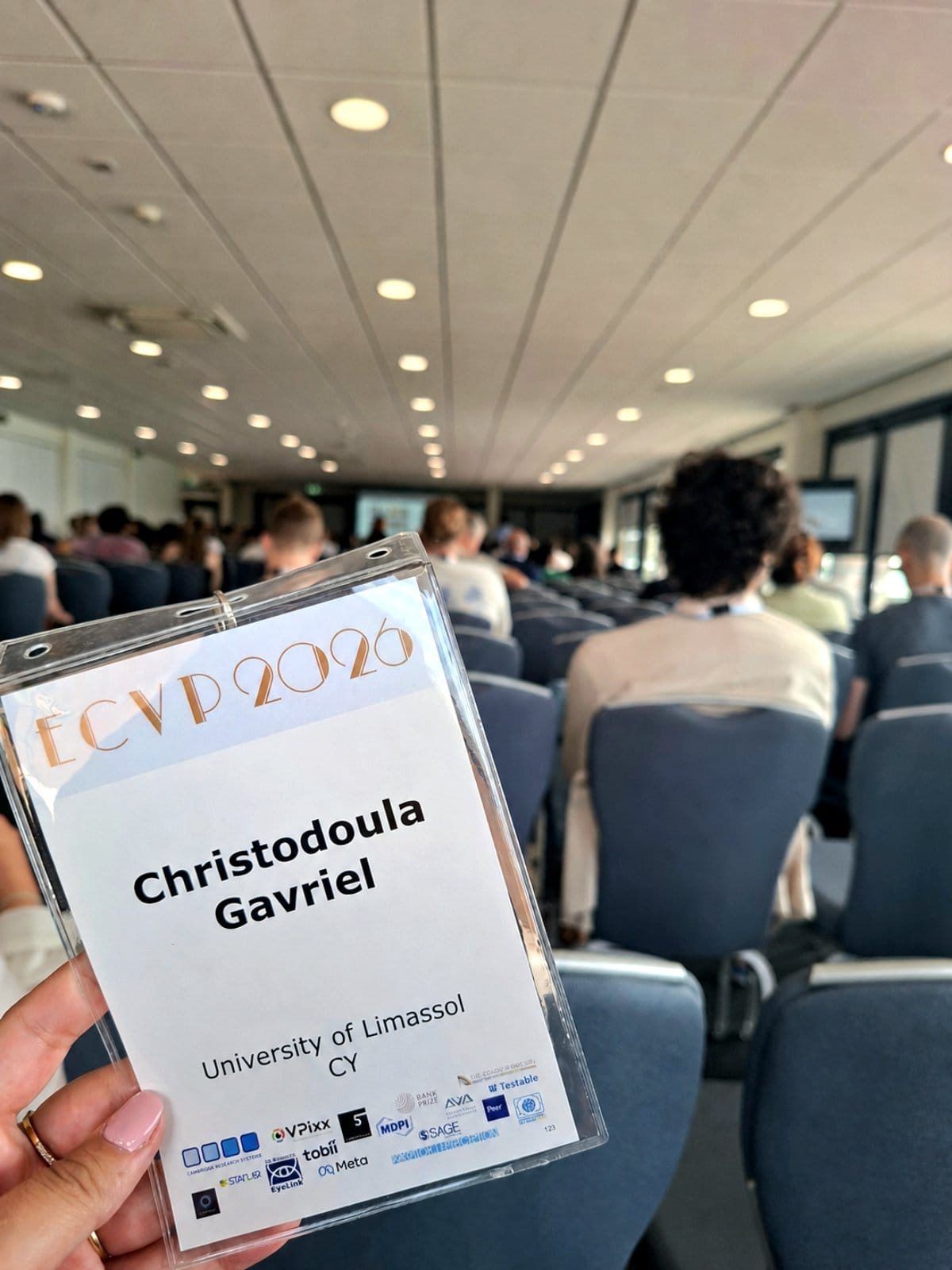
The PERiFORM project joined the international vision-science community at the 48th European Conference on Visual Perception (ECVP 2026), held in Bournemouth, United Kingdom, from 23 to 27 August 2026.

Through keynote lectures, symposia, workshops, talks, and poster sessions, the conference presented current research on multisensory perception, virtual reality, embodiment, tool use, and the relationship between perception and action.
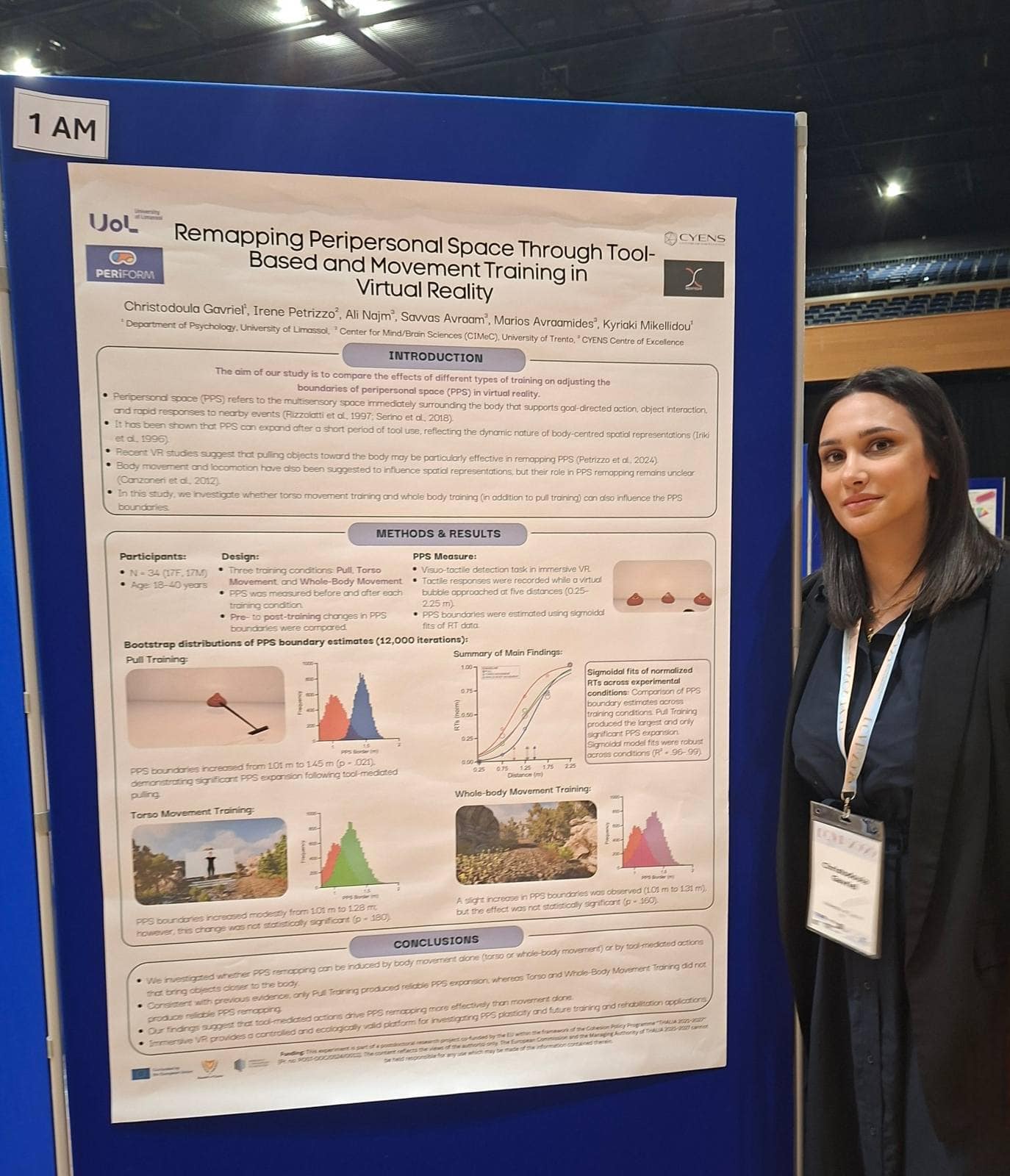
Representing the University of Limassol, Dr. Christodoula Gavriel, Principal Investigator of PERiFORM – Pushing boundaries: Peripersonal space as a tool to improve sports performance, presented the poster Remapping Peripersonal Space Through Tool-Based and Movement Training in Virtual Reality. The presentation formed part of the “Multisensory and Other Senses” poster session on 24 August.
The poster shared findings from a PERiFORM study comparing three training approaches in immersive virtual reality. Purposeful pulling with a virtual tool reliably expanded participants’ Peripersonal Space, the space immediately surrounding the body, whereas torso and whole-body movement alone did not produce similarly reliable changes. The findings show how the brain’s representation of nearby space can be reshaped by how an action is performed.
During the poster session, Dr. Gavriel discussed the study with researchers working on multisensory processing, tool use, and virtual reality. The conversations covered the project’s experimental design, how to measure peripersonal-space boundaries in VR, and the role of purposeful action in shaping body-centered spatial representations.
The conference also offered practical opportunities to develop VR experiments. Dr. Gavriel attended the hands-on workshop VR Foundations for Researchers in Experimental Psychology, which introduced participants to building experimental virtual environments using the Unity game engine.
Through live demonstrations, the workshop showed how to create and adapt virtual scenes, objects, spatial layouts, and interactive elements around a specific research task. Observing this process generated useful ideas about experimental control, user interaction, and the continuing development of PERiFORM’s virtual environments.
Across the scientific program, presentations explored how vision, touch, hearing, and action work together to shape perception. The keynote, The Early Role of Vision in Multisensory Development, examined how visual experience contributes to the development and organization of multisensory abilities. Other contributions addressed audiovisual integration, tactile perception, and correspondences between color and sound.
Further sessions examined how people adapt when acting through prostheses, virtual systems, and teleoperation technologies. Research on artificial effectors, sensorimotor delays, and spatial mismatches illustrated the flexibility of bodily and spatial representations when tools or technological systems mediate action.
Virtual embodiment formed another important part of the program. Studies investigated how experiences through virtual bodies may influence subsequent perception, alongside research on distance perception, learning in VR, and visually induced motion sickness.
A poster examining vestibular training as a possible way to reduce dizziness and motion sickness highlighted the importance of comfort, adaptation, and individual differences in immersive experiences.
Together, these presentations showed how representations of the body and surrounding space are continually updated through sensory information and action. Presenting PERiFORM’s findings within this scientific setting, learning about VR development in Unity, and exchanging perspectives with other researchers brought new scientific and methodological insights to the project’s ongoing work.
Christodoula Gavriel, Irene Petrizzo, Ali Najm, Savvas Avraam, Marios Avraamides, and Kyriaki Mikellidou authored the poster and represented the University of Limassol, the Center for Mind/Brain Sciences of the University of Trento, and the CYENS Center of Excellence.
The PERiFORM project is implemented by the European Union within the framework of the Cohesion Policy Programme “THALIA 2021–2027”, through the Research and Innovation Foundation of Cyprus [Project No. POST-DOC/0524/0011].
 English (UK)
  Ελληνικά