


Abstract
Objective
To investigate the structural, functional, and neurophysiological brain changes associated with post-COVID-19 condition (PCC)-related cognitive and psychological issues and evaluate the efficacy of noninvasive brain stimulation (NIBS) and cognitive rehabilitation interventions.
Data Sources
Electronic databases, including Web of Science, PubMed, and Embase, were systematically searched for articles published before February 1, 2025, using terms such as “post-COVID-19 condition,” “cognitive dysfunction,” “brain changes,” “noninvasive brain stimulation,” and “cognitive rehabilitation.” Language was restricted to English, and only studies involving human participants were included.
Study Selection
Studies with human participants aged ≥18 years diagnosed with PCC, employing magnetic resonance imaging, functional magnetic resonance imaging, positron emission tomography, and electroencephalography, and interventions such as NIBS and cognitive rehabilitation were included. Articles were selected through independent review by multiple authors, with consensus resolving discrepancies. Of the 123 studies initially identified, 78 met the inclusion criteria.
Data Extraction
Data on participant demographics, methodologies, neurophysiological changes, and intervention outcomes were extracted by 2 independent reviewers using predefined guidelines. Study quality was assessed using the Newcastle-Ottawa Scale and Critical Appraisal Skills Program tools.
Data Synthesis
Seventy-eight studies with over 5900 participants met the inclusion criteria. Significant cognitive impairments were observed in attention, executive function, and memory (N=78). Key findings included mixed evidence of gray matter (N=16) and white matter volume changes (N=20), cortical thickness alterations (N=9), variations in functional connectivity (N=14), electrophysiology (N=9), and blood flow (N=8). NIBS, including transcranial magnetic stimulation (N=8) and transcranial direct current stimulation (N=2), showed potential benefits for managing depression and cognitive impairments. Although cognitive rehabilitation (N=3) showed promise, it requires further investigation.
Conclusions
This review highlights the complex neurologic underpinnings of PCC and the potential of NIBS and cognitive rehabilitation as interventions. Further research is essential to refine these interventions and establish evidence-based strategies for addressing long-term cognitive and psychological effects of PCC.
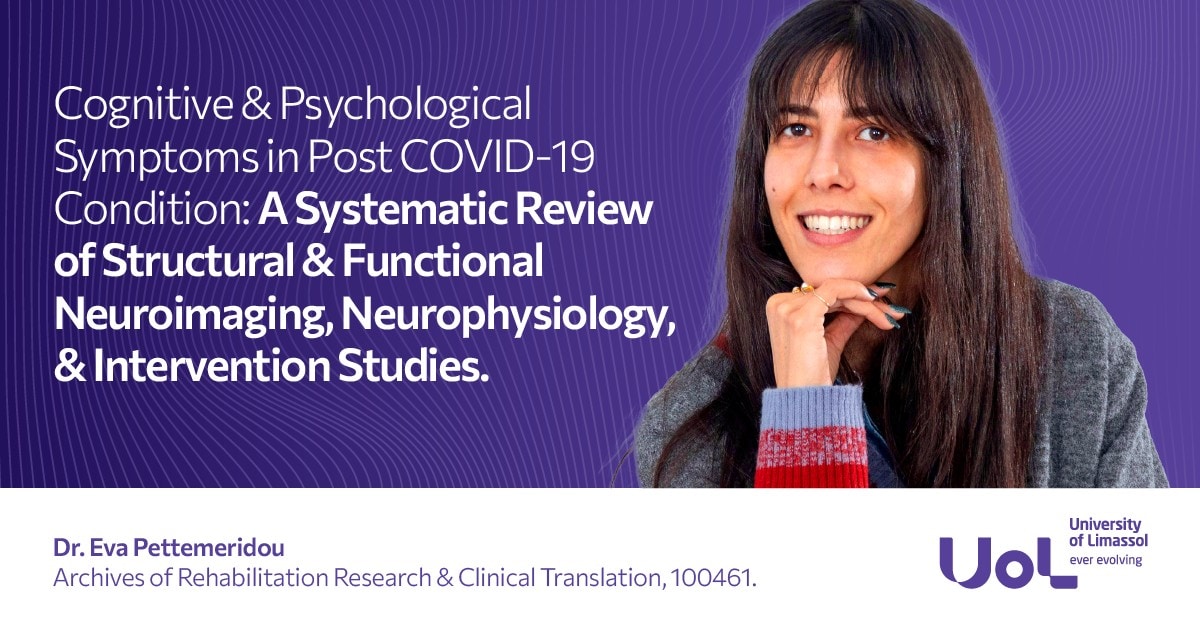
Pettemeridou, E., Loizidou, M., Trajkovic, J., Constantinou, M., De Smet, S., Baeken, C., Sack, A.T., Williams, S.C.R. Constantinidou., F. (2025). Cognitive and Psychological Symptoms in Post COVID-19 Condition: A Systematic Review of Structural and Functional Neuroimaging, Neurophysiology, and Intervention Studies. Archives of Rehabilitation Research and Clinical Translation, 100461.
 English (UK)
  Ελληνικά