


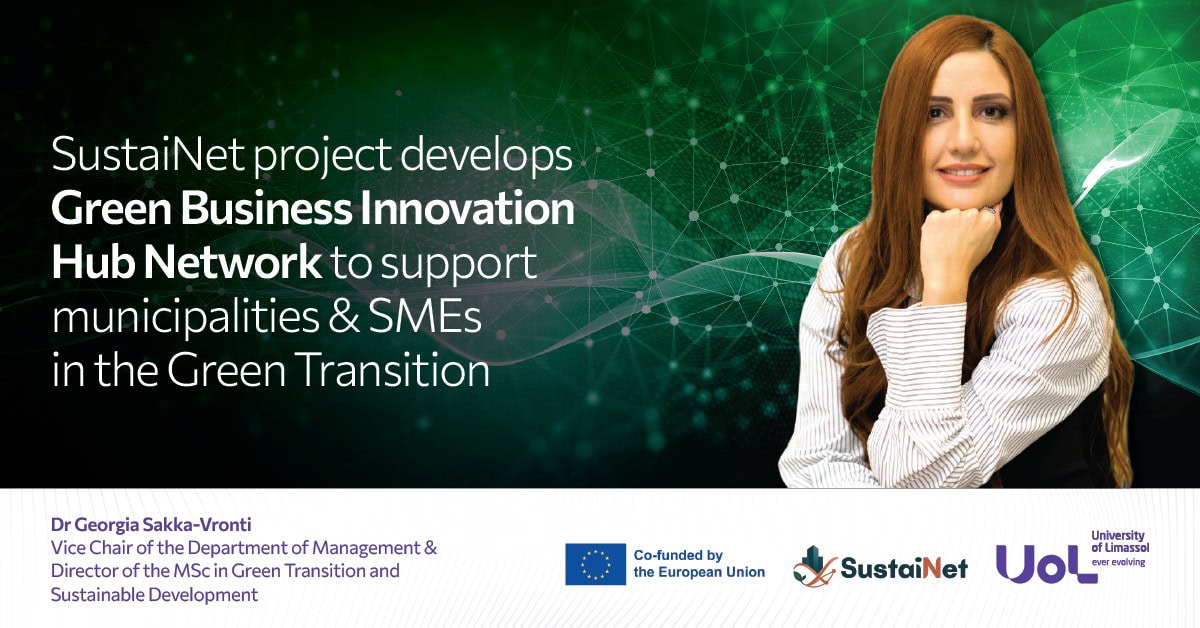
Municipalities and SMEs play a critical role in achieving Europe’s sustainability objectives. However, many local authorities and businesses still face challenges in accessing the tools, expertise, and structured support needed to implement effective green transition strategies. The SustaiNet project, funded under the Erasmus+ programme, addresses this gap by developing a network of Green Business Innovation Centres (GBICs) to support municipalities and SMEs in fostering sustainable economic development and environmental responsibility.
SustaiNet brings together academic institutions, local government authorities, and SMEs from Cyprus, Greece, and Bulgaria with the shared goal of strengthening sustainability capacity and promoting innovation at local and regional levels. Through collaborative research, practical tools, and targeted training initiatives, the project supports municipalities and businesses in transitioning to greener, more resilient operational models.
Specifically, the project aims to:
- Promote sustainable development by integrating economic, environmental, and social priorities.
- Support municipalities in designing and implementing green growth and sustainability strategies.
- Provide self-assessment tools to help local authorities evaluate their sustainability readiness and identify priority areas for improvement.
- Assist SMEs in adopting innovative and sustainable business models.
- Enhance vocational education and training and higher education through specialised training programmes focused on green skills and competencies.
These objectives directly contribute to key European and global policy frameworks, including the European Green Deal, the United Nations Sustainable Development Goals (SDGs), and the Circular Economy Action Plan.
During the initial phase of the project, the consortium conducted a comprehensive analysis of sustainability needs, skills gaps, and green transition priorities among municipalities and SMEs across the participating countries. Building on these findings, the project is currently finalising three core outputs:
- A Self-Assessment Tool enabling municipalities to assess their sustainability performance and identify improvement opportunities.
- An Online Resource Hub providing accessible training materials, practical guidelines, and examples of best practices for municipalities and SMEs.
- A Green Business Certification Programme designed to recognise and promote environmentally responsible and sustainable business practices.
Together, these tools provide a structured, practical framework to support municipalities and SMEs in advancing their green transitions and strengthening local sustainability ecosystems.
On the 27th of March, the partners from Cyprus will also launch the Green Business Innovation Challenge Event from 09:00 to 15:00 at Elias Beach Hotel in Limassol. The event will bring together startups, SMEs, research teams, mentors, and key players in the innovation ecosystem, with the aim of developing innovative green solutions. The aim is to highlight emerging trends in sustainability, enhance investment readiness, and connect promising green business ventures with funding opportunities and strategic support. The agenda to this event can be found HERE ⭷
Dr. Georgia Sakka-Vronti, Assistant Professor at the University of Limassol and Vice-Chair of the Department of Management, serves as the lead researcher of the SustaiNet project in Cyprus. She oversees the project’s strategic implementation and stakeholder engagement activities at the national level. She leads the development and execution of project activities in collaboration with the UoL Research Center, which provides institutional, administrative, and implementation support.
Through research-based development, digital innovation, and cross-national cooperation, SustaiNet contributes to building more resilient, sustainable, and future-ready local ecosystems across Europe. The University of Limassol and the Cyprus Chamber of Commerce and Industry, as project partners, actively engage municipalities, SMEs, and local stakeholders in Cyprus, ensuring that the project’s tools and initiatives address real sustainability needs and generate measurable local impact.
About SustaiNet
SustaiNet is an Erasmus+ funded project focused on supporting municipalities and SMEs in their transition toward sustainable and environmentally responsible practices. The project develops innovative tools, training programmes, and collaborative initiatives through a network of Green Business Innovation Centres, thereby advancing sustainable development and green innovation across Europe.
If you’d like to learn more about the project you can visit its website (www.sustainet-erasmus.eu ) or contact us directly at research@uol.ac.cy.
 English (UK)
  Ελληνικά