


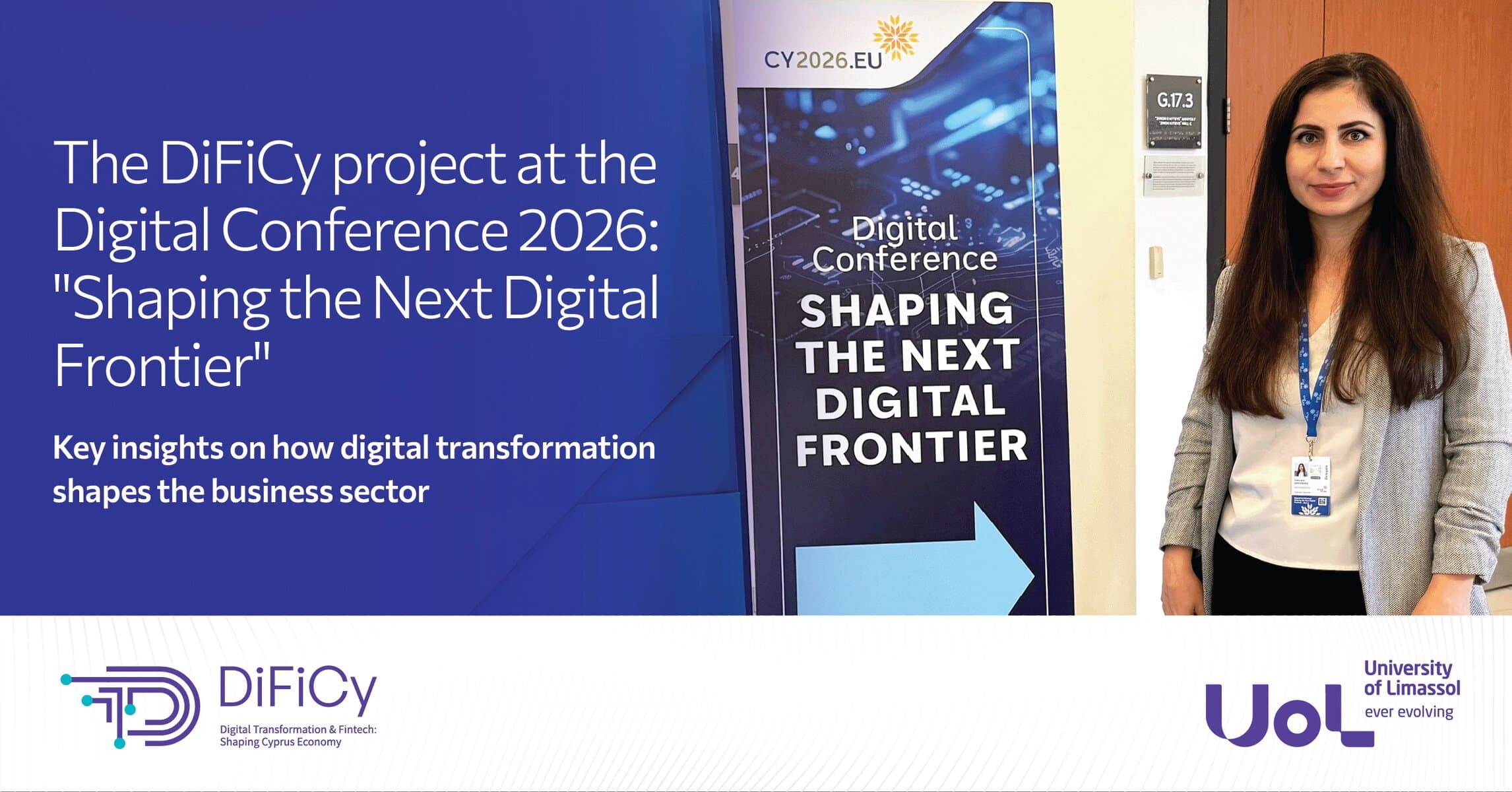
Key insights on how digital transformation shapes the business sector!
As part of the activities of the DiFiCy Project, Dr Snezana Eminidou participated in The Digital Conference 2026: “Shaping the Next Digital Frontier”, organized within the framework of the Cyprus Presidency of the Council of the European Union taken place on 17-18 June 2026 in Nicosia.
Several discussions during the conference directly reinforced the objectives and research priorities of the DiFiCy project, which examines how digital transformation and financial technologies influence business competitiveness, productivity, and sustainable economic development, particularly among small and medium-sized enterprises (SMEs).
One of the central messages emerging from the conference was that the challenge is no longer access to technology, but the speed and effectiveness of technology adoption. Speakers stressed that artificial intelligence should not be viewed merely as a technological innovation, but as a tool for creating economic value and improving productivity. However, digital adoption often requires significant organizational change, investment, and skills development, making implementation costly and challenging for many firms.
Particular attention was given to the growing digital competitiveness gap between large firms and SMEs. While larger organizations often possess the resources needed to implement advanced digital solutions, many SMEs face barriers related to expertise, financing, and scaling capabilities. These observations strongly support the DiFiCy project’s focus on understanding the determinants and economic consequences of digital adoption among Cypriot SMEs.
Another important theme concerned Europe’s ability to scale innovation. Several speakers argued that Europe does not suffer from a shortage of talent but rather from difficulties in transforming innovation into large-scale economic impact. The regulatory simplification and business scalability was highlighted as a prerequisite for strengthening European competitiveness.
The conference also emphasized the role of education, trust, and adaptability in supporting digital transformation. Building digital capabilities and equipping future generations with the skills required for an increasingly digital economy remain essential priorities for policymakers, businesses, and educational institutions alike.
These insights provide valuable input for the ongoing research activities of the DiFiCy project and further support its objective of generating evidence-based recommendations for policymakers, businesses, and other stakeholders seeking to accelerate digital transformation and economic growth in Cyprus.
The project is implemented under the programme of social cohesion “THALIA 2021-2027” co-funded by the European Union, through the Research and Innovation Foundation in Cyprus [Pr. no. EXCELLENCE/0524/0568]. The content reflects the views of the author(s) only. The European Commission and the Managing Authority of THALIA 2021–2027 cannot be held responsible for any use which may be made of the information contained therein.







 English (UK)
  Ελληνικά