


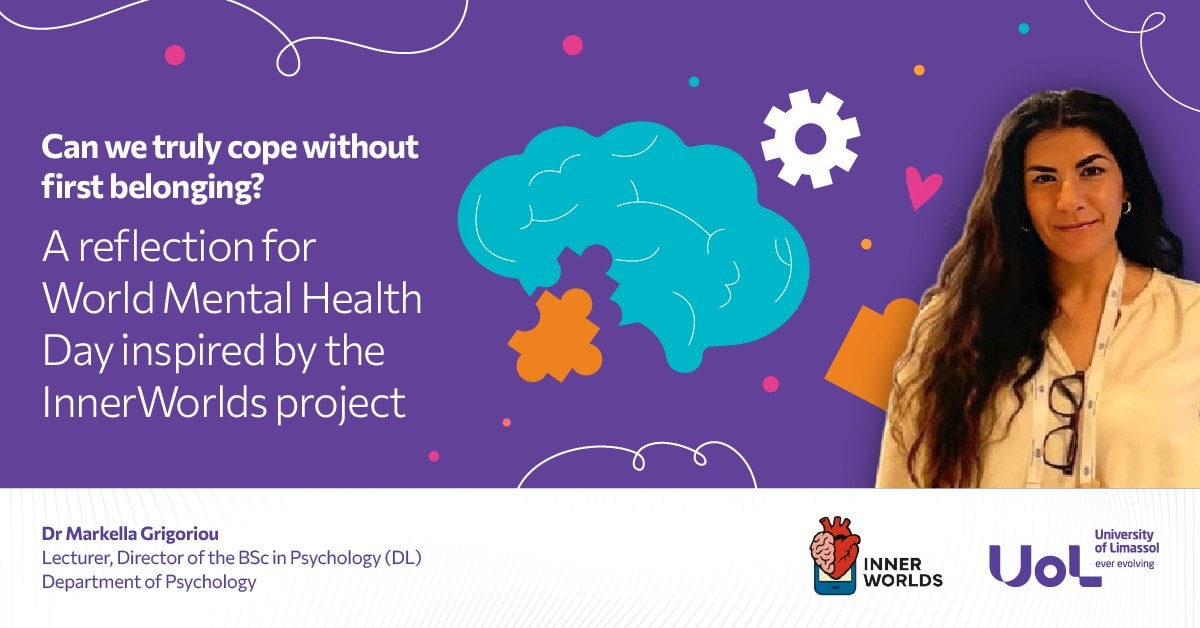
Article – UoL
We speak about mental health through the language of resilience, coping, self-regulation and intervention. Yet, beneath all these concepts lies something older and more fundamental: the human need to belong.
Belonging is more than being surrounded by people. It is the experience of being recognised, accepted and valued; of knowing that our presence matters somewhere. Human beings do not discover themselves in isolation. From childhood onwards, we begin to understand who we are through our relationships with families, friends, teachers, communities and, increasingly, in digital worlds.
This becomes particularly important during adolescence. Findings from the Work Package 2 of the European InnerWorlds project (https://innerworlds.eu/), reveal an important developmental transition in how young people understand and process their emotions. A total of 211 participants from Cyprus, Spain, Austria and Romania, participated in the co-creation sessions conducted as part of the project. Results indicated that younger adolescents (12-14) rely more strongly on social interaction and externally guided support to understand their emotions, whereas older adolescents (15-18) increasingly turn towards private reflection and internal emotional processing.
Growing inward is part of growing up. But there is a fragile boundary between autonomy and isolation. The InnerWorlds Digital Handbook suggests that increasing emotional independence is not necessarily accompanied by equally developed emotional-regulation skills. Adolescents’ willingness to communicate distress also depends profoundly on trust, psychological safety and freedom from judgement.
And this is where today’s reality becomes uncomfortable. Young people are growing up in a world of extraordinary connectivity but uncertain connection. They are continuously visible, measurable and comparable. Social media can transform belonging into approval, friendship into metrics and identity into performance. Digital interaction increasingly competes with human presence. The challenge is no longer simply whether young people can connect. It is whether, among thousands of connections, they can find relationships in which they can safely be imperfect.
We therefore need to question a mental-health discourse that repeatedly asks individuals to become more resilient while paying insufficient attention to the environments and situations to which they are expected to adapt. Perhaps people do not always need another lesson in how to withstand pressure. Perhaps they need less pressure. Perhaps they do not need to be taught endlessly how to cope with loneliness; they need communities that refuse to normalise loneliness.
This World Mental Health Day, against the backdrop of this year’s theme, “Lived experiences heard: real voices, real change,” let us attempt to redefine what belonging means in our lives. Feeling heard, understood, and connected to others is, after all, at the heart of belonging. Not belonging as fitting in, constant connectivity or approval, but belonging as being able to exist without performing; to speak without fearing judgement; to be vulnerable without becoming less worthy. Yes, resilience matters, indeed. But resilience without belonging can become merely the ability to suffer alone.
Perhaps one of the most meaningful things we can do for the mental health of our and next generations is simple: Live the life in a way that no person must choose between being themselves and belonging.
To learn more about the InnerWorlds project, its activities, and key outputs, visit the project website: Mental Health Mobile Game for Youth in Europe | InnerWorlds

The project is funded with support from the European Commission. This publication reflects the views only of the author, and the Commission cannot be held responsible for any use which may be made of the information contained therein. Project Number: 2024-2-ES02-KA220-YOU-000295176


 English (UK)
  Ελληνικά