

Egiomontanus angle maximisation stems from the work of the 15th-century German mathematician Regiomontanus, on observational astronomy. He discovered that the angle at which a celestial body’s path appears is greatest when the body is sufficiently high above the horizon in the sky. This principle applies to everyday observations on Earth as well.
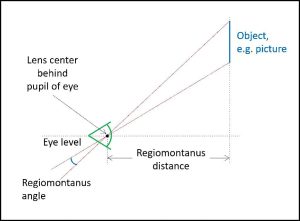
For instance, consider a picture hanging on a wall. Suppose the picture is positioned above eye level. In that case, a viewer must step back to see it clearly, as shown in Fig.1. Standing too close to the wall makes the picture hard to view while being too far away diminishes visibility. The optimal viewing distance, where the picture appears at its largest and most visible, is called the Regiomontanus distance.
The same principle applies when photographing a picture. The use of conventional lens-based cameras for photography has several limitations. These cameras have a restricted field of view and can distort objects parallel to the line of sight, such as rail lines appearing to converge in the distance.
Using multiple cameras can address some of these issues, but this approach is costly and complex, requiring careful calibration of each camera individually and together with the others. Additionally, conventional cameras often produce rainbow colour distortions, where different colours create superimposed and misaligned



 English (UK)
  Ελληνικά