

At the end of May, the University of Limassol, as an Academic Partner, participated in the DOERS Summit in Limassol. The following challenge was discussed during the panel discussion entitled “Who Builds the Future: Why Education Is Becoming Everyone’s Business”.
The future workforce is shaped long before people enter the job market, yet responsibility for that process remains fragmented. Traditionally, education has been seen as the responsibility of the State and academic institutions, while companies simply act as end consumers of talent. But the fast-changing, global tech ecosystems challenge this model.
As industries evolve faster than traditional systems can adapt, education is becoming a shared responsibility between governments, universities, startups, corporations, and technology platforms.
In connection with that, who should shape the workforce of the future, how collaboration between education and industry must evolve, and what skills will matter most in an AI-driven world.
Let’s start with the workforce. The workforce of the future will consist of humans, digital agents, and physical robots. This is a disruptive change with immediate aftermaths. Part of the workforce, namely digital agents and physical robots, will be built not by academia but by industry. Another effect, entry-level positions are likely to be automated first by AI. That will complicate the onboarding of recent graduates by companies.
Companies hire workers for their skills. These skills should match companies’ requirements. Due to AI, companies have to redesign the workflows of their operations around people, agents, and robots, taking into account what people and intelligent machines do best. Machines should handle routine tasks, while people frame problems, provide guidance to AI agents, interpret results, and make decisions. Work will be increasingly focused on collaboration with intelligent machines and oversight of them.
Human skills will evolve as people work closely with AI. This means that the next actor in the education-to-workforce pipeline – academia – should also change. Curricula must be continuously renewed to reflect current and emerging technologies. People must learn how to use and guide technologies effectively. AI will come into university classrooms as an individual assistant, ready to answer any student’s question at a professor’s level and to guide students through personalised learning paths.
As of now, the performance of companies is regulated by market mechanisms, i.e. demand and supply forces. Let’s take the financial industry as an example. Young people who do not consider building a career in finance don’t want to learn financial literacy. Instead, they are ready to delegate their personal finances to AI. The position is simple: if I need a loan or a banking card, I do not want to be involved in that process; Agentic AI can do that on my behalf, and even better than I could. As AI agents choose which bank to proceed with, part of the demand in the market will be created by AI rather than by people.
What about the supply side? Let’s answer the following question. When an AI agent, acting on behalf of a person, calls a bank, who will respond to that call: a bank employee or an Agentic AI? It looks likely that it will be an Agentic AI, meaning that part of the supply will also be digital, created by AI.
But technology alone will not create value. Although AI fundamentally alters the ratio between technology and humans in organisations, and work is increasingly centred on collaboration between humans and intelligent machines, while managerial work is shifting from supervising people to orchestrating systems in which people, AI agents, and robots collaborate, humans will retain the primary role in companies.
University of Limassol constantly monitors these changes and acts proactively. For example, in the area of finance, an Industry Advisory Board has been created with the main focus on continuously aligning curricula with industry needs. The MSc in Digital Finance[1] program, with a fully updated curriculum, will start in the Fall semester of 2026. Previous curricula included Corporate Finance, Company Valuation, and Managerial Economics. The brand-new curriculum includes Blockchain and Decentralised Finance, Applications of AI in Finance, Data-driven Financial Analytics, and Digital Transformation of Financial Institutions and Services.
Other forms of close cooperation with industry include guest lectures and hands-on classes organised by industry experts from leading companies, joint webinars on industry developments, participation of student teams in professional challenges, and academic partnerships with industry associations. Two research projects should be specifically highlighted: Crypto Expert Survey[2] and Digital Transformation and FinTech: Shaping Cyprus’ Economy[3]. Both projects are industry-oriented and involve the collection of data from industry experts.
How can an individual prepare for these disruptive AI-driven changes in industry? The answer is simple: skills create talent. Continuous learning is extremely important during this turbulent period. And not only the technology skills matter. Transferable skills such as communication, problem-solving, critical thinking, teamwork, leadership, and self-development are equally important. Building transferable skills through academic studies will prepare individuals for a more fluid job market, making them more adaptable and better prepared for change.
From the academic side, we welcome everyone to study with us and remain open to cooperation with industry[4].
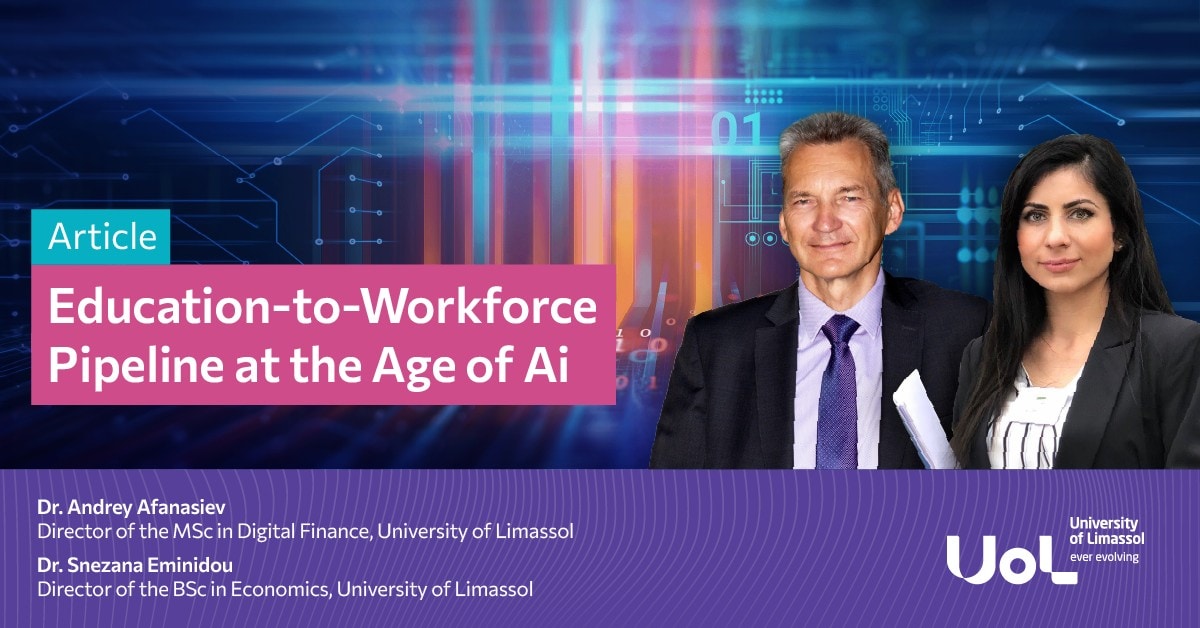
Dr. Andrey Afanasiev
Director of the MSc in Digital Finance
University of Limassol
Dr. Snezana Eminidou
Director of the BSc in Economics
University of Limassol
[1] https://www.uol.ac.cy/en/program/msc-in-digital-finance/
[2] https://www.uol.ac.cy/en/research-projects/crypto-expert-survey-cyprus/
[3] https://www.uol.ac.cy/en/research-projects/digital-transformation-and-fintech-shaping-cypruss-economy/


 English (UK)
  Ελληνικά