



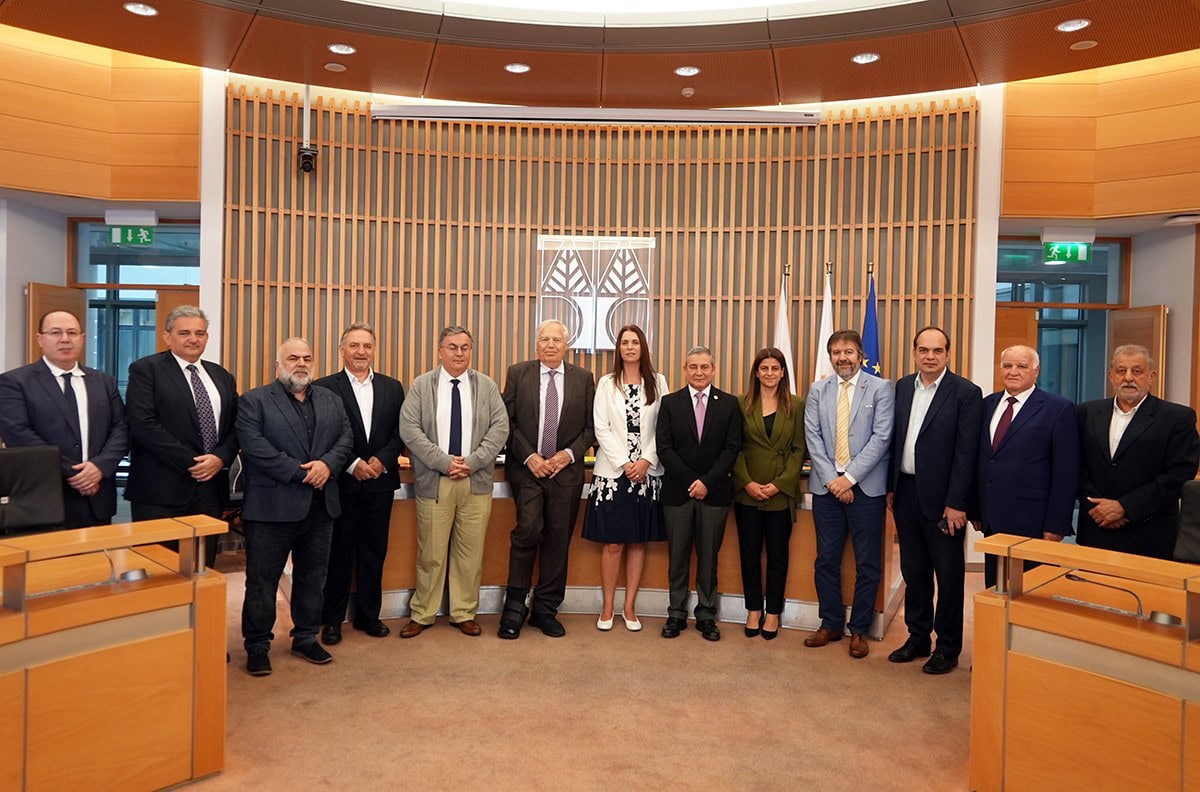
On 2 February 2024, a press conference was held on the initiative to establish a new UN headquarters in Cyprus.
Dr. Andri Hadjiandreou, Director of the UoL Center for DEI, was invited to the conference for her intervention.
Her speech follows in full:
“It is with great pleasure that I am here today to support such an aspiring initiative. At the same time, as a man of culture, it is with great emotion that I take the opportunity to read a few words and share a few thoughts with you, in the hope that some of them will contribute to the smooth transition of tomorrow’s solution of the Cyprus problem, but also of so many other “tomorrow’s solutions” that will be given to the wider region. which are linked to the solution of the Cyprus problem. Tomorrow’s solutions are crowded with multiple biographies of people, ready to be classified in the light of globalization and nationalism, within a complex of international and local redefinition.
Buckle up, some will say. The take-off of the solution is dangerous, and multicultural! Bond politically, socially, economically, and militarily. Set yourself free, others will say. Multicultural landing is urgent. Urgent for groups of people who feel inferior, oppressed, and unrecognized. The multiculturalism of the solution of the Cyprus problem, which for some is considered the worst threat, for these groups is a political demand over time, which contributes to their collective demands.
It is through this lens that I read this initiative, to transform Cyprus from a problem into a solution. Through the lens of reshaping world politics based on culture and not at its expense. Through the lens of modernizing politics, not in the sense of global civilization that aims to westernize non-Westernized peoples and societies, but with the understanding that contemporary politics is the politics of cultures, while local politics is the politics of nationality.
This, of course, implies the convergence of cultures and not their clash. The harmonization, not the regression between who I am and who they want me to become. For it is these regressions that create boundary lines, which, in any case, move within the temporal-historical framework of conflicts and wars, directed, dare I say it, by emotional hypocrisy.
Just consider how short our attention span is when it comes to wars and how easily we move from one borderline to another. How easily people, governments, and officials move from waving the Ukrainian or Russian flag to choosing sides between Israel and Palestine. And how difficult it is to simultaneously manage the multiple ongoing conflicts from Syria to Ethiopia to Myanmar, and from Somalia to Haiti to Congo, in particular, when today we are called upon to work with people from all these corners of the globe.
With the upcoming European and other national elections winking at us around the world, but also with Ms. Cuellar’s six-month stay on the island, discussions about local and global, national and multicultural, are expected to become more intense, and increasingly polarized. And it is for this very reason, that I also choose, to refer to the Alliance of Civilisations as a United Nations entity, which was officially launched by UN Secretary-General Kofi Annan in 2005, with the co-support of the governments of Spain and Turkey. My choice stems from what is happening in the wider area of Cyprus, but also from the role that the establishment of another United Nations headquarters here in Cyprus could play. Namely, the role of Cyprus in mobilizing international action against extremism, through the encouragement and establishment of international intercultural and interreligious dialogue and cooperation, and their importance in promoting tolerance.
French economist and diplomat Jean Monnet said, “Nothing is possible without man, nothing lasts without institutions.” About a century and a half earlier, writes the German poet and philosopher Johann Wolfgang von Goethe, “Children must take two things from their parents, roots and wings.” I paraphrase France and Germany: Two things people must take away from their institutions, roots and wings.
And in this sense, that is, the concept of the balance between the rooted and the liberated, the interrupted and the lasting, the local and the global, we want, and can be led to, a meaningful interpretation of democracy. A democracy that ensures the continuous process of harmonious coexistence, adaptability, and flexibility. A democracy that does not allow international humanitarian law to fall into legal loopholes when wars take off, nor to throw up their hands when they land. That is, when a war is declared, not between two states, but between a state and a terrorist organization, a state, and an ideology, as in the case of Israel and Hamas, thus allowing ethnic cleansing to unfold unfolded before the eyes of the international community.
A healthy democracy allows ordinary people to thrive and humble leaders to build just and inclusive societies. The “House of One” in Berlin, for example, is intellectually spacious, a common edifice that fits a church, a mosque, and a synagogue under the same roof. It’s no wonder why such a house doesn’t make headlines everywhere. It is also surprising whether such a roof could be a cornerstone of the new headquarters of the United Nations, here in Cyprus. I therefore welcome this initiative, and I hope that the effort will succeed, because when, in my opinion, everything else has failed, it is culture that will have to provide and take on the solutions. Thank you.

 English (UK)
 Ελληνικά